
Tony Pulis did not fit in at Crystal Palace, despite his impressive ability to grind out results and ensure Premier League survival, writes Matt Woosnam*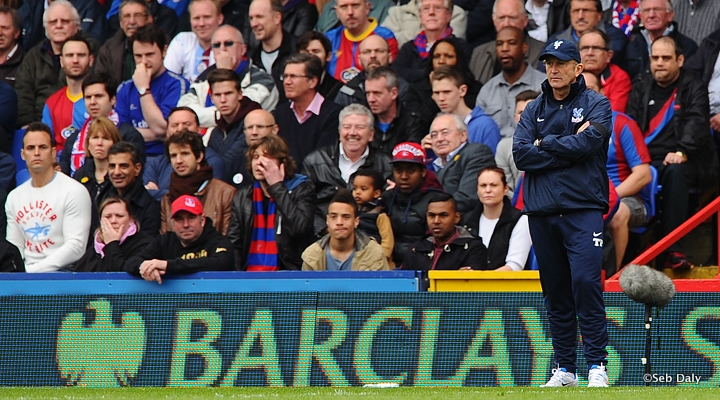
‘Crystanbul’ they called it. Tony Pulis’ Crystal Palace side were trailing 3-0 to a rampant Liverpool side, desperate to keep their hopes of winning the Premier League title alive, and then, well then came the resurgence.
Three goals in no more than nine second half minutes destroyed the Reds’ hopes and saw the Eagles make a stunning comeback to draw 3-3. Never before did it feel so right, so good, so perfect to be a Palace fan. Brighton away in the play-offs, Watford in the play-off final; both wonderful moments, but having beaten Chelsea a month before, then make a comeback to draw 3-3 with one of the best Liverpool sides in recent years; not the mention it being under the Selhurst Park lights, was quite simply, incredible.
The trouble is though, what we saw that night was the rigid, disciplined, well drilled Palace squad Tony Pulis largely inherited. There is no doubt that the former Stoke boss worked wonders for the confidence of the squad, the defensive shape and tactical awareness; and in some ways, he worked wonders for the club too; but he was never the right manager for the club.
It is worth noting that Pulis apparently turned down the manager’s job first time around, he wasn’t keen to join a club languishing towards the bottom of the Premier League; perhaps fearing a blemish on an otherwise perfect record of no relegations in his time as a manager. Eventually he was convinced to take the job, and what a job of it he did. He took the side to an 11th place finish and securing an unprecedented second consecutive season in the Premier League. However, something just didn’t feel right, and it isn’t easy to pinpoint exactly what, you could just feel that there was never a long term plan; it was all about the here and now.
Different managers have different opinions on players and decide not to play them or use them in their squads, but with Pulis, there is little room for manoeuvre. Jonathan Williams and Barry Bannan were both marginalised under his management; likewise was Dwight Gayle – the best finisher in Palace’s squad – because they did not suit his style of play, they did not suit the type of player that he appreciated. Young, slight and attacking in the centre of the pitch, Williams and Bannan never stood a chance. The phrase “Pulis type player” did not come about by itself; there were certain players who, unless they were significantly better than taller, stronger, harder player, would not be given an opportunity.
Why is it a problem that a manager doesn’t pick certain players? Well, it isn’t, the problem is with development. Tony Pulis was not interested in picking or signing players who needed to be developed. The player had to be perfectly ready to play a leading role in the team. Sure, it worked out well last season but in the future to be a sustainable football club you have to buy players who need developing, and then develop them. That is also the way the club was supposed to be heading under CPFC2010, but it seems to have been disregarded in an attempt to chase the much needed money from retaining a Premier League spot. The trouble with that is there is no way to guarantee Premier League survival, no matter how much you spend. At least by developing young players, you have valuable assets on lower wages to be sold on for a profit in the future, or to remain at the club and propel a potential promotion push should relegation ensue.
I have admiration Pulis’ ability to manage a team, but that's as far as it goes. He manages a team and a squad. He doesn't manage a club. Clearly there was a set idea of which players he liked and he stuck with that largely whether they were on form or not. Other players were marginalised because they did not suit his style. He had every right to do that, but I didn't feel it was right for the club.
Pulis was not right for the club. It just didn't feel right and I can't put my finger on exactly why. The way he spoke about the club seemed very distant - he didn't have to love the club, but a club like Palace needs to have some element of love and emotion involved in every part of the club to connect it to the supporters properly. There has to be a desire to do well for the club, not to do well because it is your job, because if you don't invest your energy into creating a better club, it won't work out well. If you have an element of wanting the club to progress for progression's sake and for the good or the club and not just to prove you can do your job well, then you'll end up with a more united club going forwards.
There is no criticism of Pulis for doing his job, he was employed to ensure Palace remained a Premier League side, and, despite some dull football, there were also enthralling matches; the victory over Chelsea and comeback against Liverpool two of the most noteworthy. It was Crystal Pulis, not Crystal Palace. Too much focussed on one man, which is why a head coach option with a solid infrastructure is perhaps the better option for a club like Palace; where the owners have a clear vision of what they want. It was evident that things were not always harmonious between Pulis and the owners at Palace, but with a set-up already in place geared towards retaining a club connection in Keith Millen, with Sporting Director Iain Moody largely in control of transfer activity, taking entire control away from Pulis, it was a marriage doomed from the very beginning.
Steve Parish is a man who likes to be in control of everything at his football club, and that is understandable; it is a club which plunged into administration twice in less than two decades and was revived reluctantly from its death bed by four men who have an attachment to the club. They are all businessmen and they want the club to succeed because they love the club, but also because it ensures their financial risk proves to be anything but that. Throw in an old-fashioned manager who likes to control the club from top to bottom and you cause a conflict of interest. Inevitably there must have been clashes, and Pulis’ vision for the club appeared distant to that which CPFC2010 set out upon its purchase; to invest in players in and coming up to their prime, to utilise the academy, and to build a sustainable football club. Under Tony Pulis, Crystal Palace would never have become a sustainable football club, and that is perhaps the underlying reason for his departure, a disagreement over the direction of the club. Palace could not afford Pulis.
The choice appears from the outside, to have been between a sustainable football club or a football club which despite being stable in the Premier League was unprepared for life outside of it. The club will be relegated at some point in the future, and it has to prepare for that, Pulis is a superb football manager, but it would have been a road to ruin had he remained at the club.
*This piece originally appeared in Five Year Plan issue 41 in September 2014.